History
History of Seattle
 |
| https://twitter.com/seattletimes/status/807046618679771136 |
Indigenous Tribes of Seattle
Archeological evidences show that the region has been inhabited by humans for at least 12,000 years. The indigenous tribes had been around since the 6th century. Before the settlers' arrival to Seattle, thirteen prominent Indian villages existed in the area. The people near Elliot Bay, along the Duwamish, Black and Cedar Rivers were collectively called the doo-AHBSH or Duwamish people. The area had extensive tidelands and the waters provided the tribes with a rich seafood source. Around the Lake Washington lived the hah-choo-AHBSH the 'Lake People'. The two tribes became identified as the people of the Duwamish tribe.
dzee-dzee-LAH-letch was the most prominent village on Elliot Bay with around 200 inhabitants. Eight large khwaac'ál'al (longhouses) and a potlatch house (a sanctuary like house, where indigenous people practiced gift-giving feast and gatherings) were located in the area.
George Vancouver was the first European to visit Seattle area in May 1792 to map the area and locate the Northwest Passage. His report about the economic possibilities encouraged further British exploration.
Seattle was founded by the Denny party a settler group from Illinois. They arrived at Alki Beach on November 13, 1851 and settled down in the area.
 |
https://cdm16786.contentdm.oclc.org/digital/collection/imlsmohai/id/8677"Surviving members of Denny Party at Alki Point monument, Seattle, November 13, 1905" |
The Denny party consisted of 10 adults and 12 children:
Arthur A. Denny, his wife Mary Ann (Boren) Denny (1822-1912), their children Louisa C. Denny (b.1844), Lenora Denny (1847-1915), and Rolland H. Denny (b. 1851);
Arthur's brother David T. Denny (1832-1903);
Carson D. Boren (1824-1912), his wife Mary Boren (1831-1906), their daughter Gertrude Boren (1850-1912), and Carson's younger sister Louisa Boren (1827-1918);
William N. Bell (1817-1887), his wife Sarah Bell (1819-1856), and their daughters Laura Bell (1842-1887), Olive Bell (b. 1846), Virginia Bell (1847-1931), and Lavinia Bell (1851-1857);
John Low, his wife Lydia Low (1820-1901), and their children Alonzo Low (b. 1844), John N. V. Low (1847-1902), Mary Low (b. 1842), and Minerva Low (1849-1858);
Lee Terry;
Lee Terry's brother Charles C. Terry (1830-1867).
Later, others followed them or settled down at different locations.
The settlers had an unsteady relationship with the Natives. They took away their lands and treating them terribly caused both sides to engage in fights, despite some settlers believed in peaceful coexistence.
In 1853 the Town of Seattle got the official name honoring Chief Sealth who led the Duwamish and Suquamish Tribes and he was friendly towards settlers. Sealth Chief was an important key character who helped the European settlers to find their new home and protected them during the Indian wars. It is believed he had had met with the first pioneers who entered Puget Sound and he had a long-lasting relationship with the newcomers.
Treaty of Point Elliot 1855
https://www.tulalipnews.com/wp/2018/07/27/the-treaty-of-point-elliott-a-living-document/
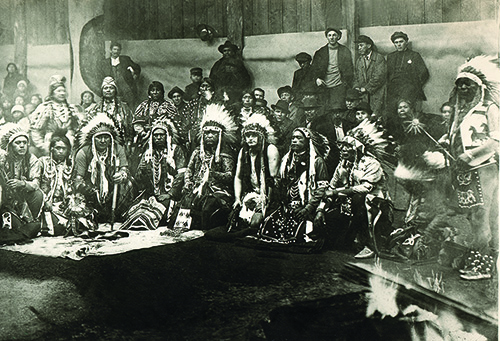
A land settlement treaty between the United States government and the Native American tribes in the Puget Sound region. Chief Sealth and Isaac Stevens, territorial governor signed the treaty with the leaders of the other tribes. It was ratified in 1859. The Treaty guaranteed hunting and fishing rights and reservations to all tribes represented. The Duwamish tribe exchanged over 54,000 acres of their homeland, including the cities of Seattle, Renton, Tukwila, Bellevue, and Mercer Island and much of King County.
The Indian Wars, also known as “The Battle of Seattle” hostilities continued and tension grew among tribes and the European immigrants. A battle between the tribes was fueled by the settlers.
First Businesses
 |
| https://www.historylink.org/File/1041 |
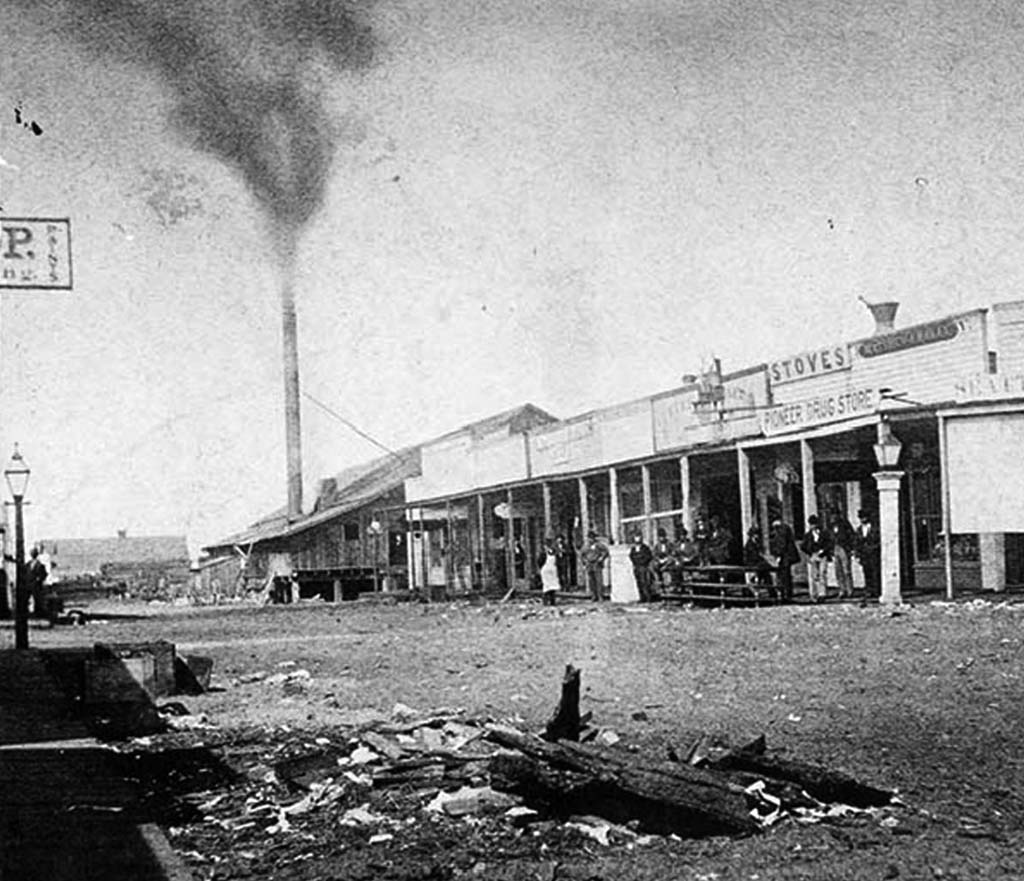
Seattle first income came from logs and later mills and milled timber because of the richly forested environment. In the early years the economy relied on the timber industry and commerce. Henry Yesler who started a stream sawmill became the first richest man of the city and Arthur Denny became the second. Seattle’s economic growth started and the first businesses and industries appeared. The city was incorporated in 1869 the population was approximately 350 and 1,000. In the 1870s coal was discovered near Lake Washington and miners were European and Chinese immigrants and the city slowly grew until the interstate railroad line arrived and laid the ground for endless possibilities and the rapid growth of the city; coal mines, transportation of logs became much easier. The growth of fishing, wholesale trade, shipbuilding, and shipping contributed to the economic expansion and population growth.
The Great Fire of 1889
 |
| https://www.historylink.org/File/1041 |
Many of the early cities were entirely built by logs. The Great Seattle fire made 29 city blocks uninhabitable and destroyed the central business district. The unfortunate event gave opportunity for municipal improvements (advanced streets, fire department, etc.). The reconstructions benefited the city in the end. New zoning code resulted in construction of brick and stone buildings and after the fire the population grew from 25,000 to 40,000 citizens.
The Klondike Gold Rush
The discovery of gold near Canada’s Yukon territory and in Alaska made Seattle an important center, people arrived from all over the globe. They established shipping lines to transport gold. The city’s population became highly diverse and the first neighborhoods developed at this time. Communities of Chinese, Jewish, Italian, and Filipinos were growing.
Downtown Seattle was prosperous, as inhabitants moved out new immigrants took their place. The city was expanding dramatically. Two railroads, the Union Pacific and Milwaukee Road systems reached Seattle. The International District developed during the 1900s.
Seattle sponsored a World Fair in 1909 to display the city’s magnitude and celebrate the economic and cultural links they established throughout the years.
 |
| https://hu.pinterest.com/pin/421719952578057421/?lp=true |
"The L.C. Smith building was completed in 1914 symbol of the metropolitan aspirations."
The Expanding City
 |
| https://pauldorpat.com/2015/03/07/seattle-now-then-going-postal-and-marion-western/ |
Later between the world wars Seattle’s economy stagnated. Worker strikes highly impacted the city and the shipbuilding industry transformed just as the manufacturing industries. The Great Depression set the economy back, but the beginning of the second world war opened shipbuilding yards up and Boeing brought his company to Seattle. So, we can say that the wars had a positive effect on the Seattle economy and the company had a great part in it.
During the war immigrants and ethnic minorities arrived to the city to take advantage of wartime work but employment discrimination and ethnic segregation in housing and public services benefited the whites.
In the 1950s freeways were being built and housing boomed to serve the growing population. In 1960s the population reached 500,000. A program ‘Urban Renewal’ changed the city’s outlook, the downtown area was reconstructed and skyscrapers replaced residential areas. Sprawl constantly demanded more roads. A second World’s Fair took place in 1962.
In the early 21st century Seattle became a home to biotechnology, high-technology, Internet commerce, and environmental engineering. Microsoft the world’s most profitable corporation brought the company to Seattle attracting other companies to choose the city over others, companies like Amazon, Starbucks and Nordstrom were also founded in Seattle. International trade is the most dynamic sector, thanks to its location and infrastructure that facilitates export. The workforce is generally educated and large. The city became a chief financial and commercial centre.
Sources:
Sources:

Megjegyzések
Megjegyzés küldése